
 Applications
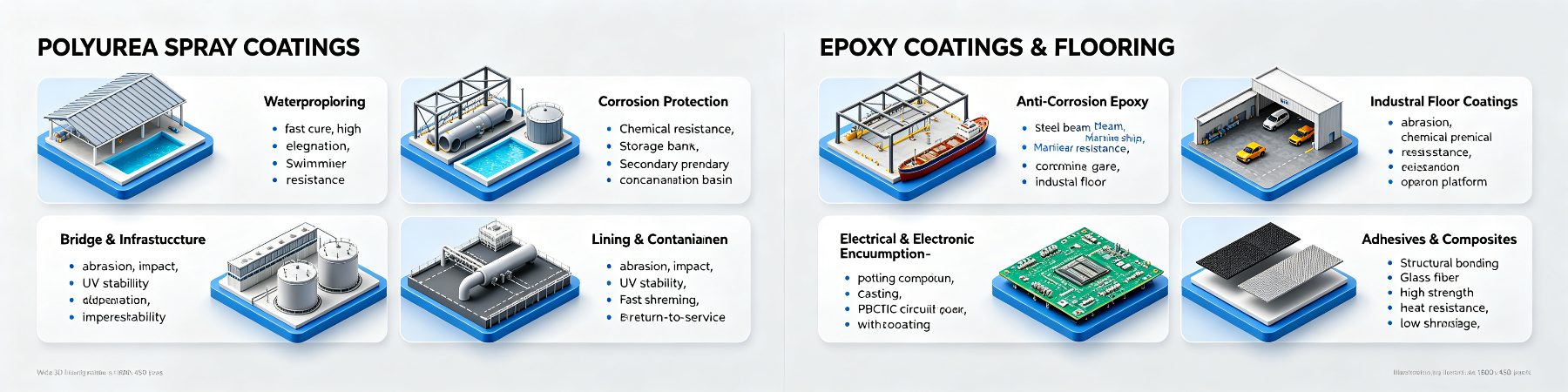
 Epoxy resins and polyurea systems represent two of the highest-performance polymer platforms in industrial coatings, flooring, construction, and corrosion protection. FINEMAX CHEM supplies a focused range of amine-based curing agents and co-reactants — including Polyether Amine (PEA), DETDA (E-100), and DMTDA (E-300) — that serve as essential components in both epoxy curing and polyurea spray systems, delivering fast cure, high mechanical strength, and superior chemical resistance.
Application
Common Production Challenges
No. | Challenge & Impact | Cause | Raw Material Solution |
1 | Too-fast or too-slow cure — insufficient working time or slow production throughput. | Amine curative reactivity mismatch, incorrect mix ratio, temperature variation. | Select DETDA for fast cure (gel 15–60 min); DMTDA for extended pot life (30–90 min); PEA MW selection controls reactivity (lower MW = faster); provide precise AHEW (Amine Hydrogen Equivalent Weight); recommend heated substrate for consistent cure. |
2 | Incomplete cure / surface tackiness — reduced mechanical properties, poor chemical resistance. | Incorrect stoichiometric ratio, moisture contamination, low cure temperature, amine blushing. | Ensure precise mix ratio (±2%) using calibrated equipment; use low-moisture amine (<0.1%); specify minimum cure temperature (15°C); recommend DETDA (less prone to blushing) vs. aliphatic amines; provide post-cure schedule (60–80°C × 2–4h). |
3 | Poor adhesion to concrete/metal — delamination, blistering, coating failure. | Amine blush on surface, substrate contamination, incorrect surface prep, low wetting. | Use DETDA/DMTDA (low blushing) vs. aliphatic amines; recommend proper surface preparation (CSP 3–5 for concrete, SSPC-SP10 for steel); select PEA with good wetting properties; recommend primer coat; ensure substrate temperature > dew point. |
4 | Bubbles / pinholes / outgassing — aesthetic defects, reduced barrier and corrosion protection. | Moisture in amine/isocyanate, high viscosity trapping air, concrete outgassing, improper mixing. | Require low-moisture PEA (<0.05%) and isocyanate (<0.03%); use nitrogen-blanketed packaging; recommend vacuum degassing for castings; control concrete moisture (<4%); use slow-reacting DMTDA for outgassing escape; recommend proper mixing technique. |
5 | Insufficient chemical resistance — coating softening, staining, degradation in industrial environments. | Low crosslink density, insufficient Tg, incorrect curative selection, under-cure. | Use DETDA curative for high Tg (120–160°C) and crosslink density; increase curative ratio for higher hardness; ensure full cure (post-cure at 80°C); recommend chemical immersion testing for specific media; select aromatic amine (DETDA/DMTDA) over aliphatic for chemical resistance. |
6 | Moisture sensitivity during cure — blushing, amine blush, reduced performance in humid conditions. | Aliphatic amine reaction with CO2/moisture, high humidity, low temperature. | Use aromatic amines (DETDA, DMTDA) which are less prone to blushing; specify minimum application temperature (15°C) and humidity (<85% RH); recommend PEA with reduced blushing tendency; use film-forming additives; provide humidity-specific formulation guidance. |
7 | High exotherm during thick-section cure — cracking, thermal stress, part distortion. | Fast-reacting curative in thick sections, high ambient temperature, insufficient heat dissipation. | Select DMTDA (slower reactivity) for thick sections (>10mm); use PEA (MW 400–2000) to moderate exotherm; recommend step-cure schedule (room temp → 60°C → 80°C); control ambient temperature (20–25°C); use cast-in layers for very thick sections. |
8 | VOC and regulatory compliance — low-VOC requirements, worker safety, environmental regulations. | High-volatility amine curatives, unreacted monomer, solvent-based formulation. | Use low-volatility aromatic amines (DETDA, DMTDA boiling point >250°C); specify 100% solids formulation; ensure REACH registration for all amine curatives; provide SDS and exposure limit data; recommend PPE guidance; offer water-borne or high-solids alternatives. |
Recommended Raw Materials
Polyether Amine (PEA) — Core polyurea component / epoxy co-curative
Key applications: Waterproofing, Corrosion Protection, Bridge & Infrastructure, Lining & Containment (polyurea R-side); Industrial Floor Coatings, Anti-Corrosion Epoxy, Adhesives & Composites (epoxy co-curative).
Solves: Too-fast/too-slow cure (MW selection), poor adhesion, bubbles/pinholes (low-moisture grade), high exotherm (MW moderation).
High-reactivity amine with terminal primary amine groups on a polyether backbone. Core component of fast-curing polyurea spray systems (R-side), enabling gel times of seconds to minutes. Also used as co-curative/flexibilizer in epoxy systems for impact resistance, adhesion, low-temp performance. Available in MW 230, 400, 2000; di- and tri-functional. Low-moisture grade (<0.05%) available.
DETDA (E-100) — Aromatic diamine curing agent
Key applications: Bridge & Infrastructure (fast cure), Industrial Floor Coatings, Anti-Corrosion Epoxy, Electrical Encapsulation, polyurea chain extender.
Solves: Too-fast/too-slow cure (fast cure option), incomplete cure, insufficient chemical resistance, moisture sensitivity (low blushing).
Diethyltoluenediamine — sterically hindered aromatic diamine with controlled reactivity. Widely used as chain extender/curing agent in polyurea and PU-polyurea hybrid systems. Also serves as epoxy curing agent for high-temperature applications (Tg 120–160°C). Fast demold, good dynamic performance, lower-toxicity MOCA alternative. Less prone to amine blushing vs. aliphatic amines. Purity ≥97.5%.
DMTDA (E-300) — Extended-pot-life aromatic diamine
Key applications: Large-area polyurea, thick-section epoxy casting, Electrical Encapsulation, large composite parts.
Solves: Too-fast cure (extended pot life), high exotherm (thick sections), incomplete cure.
Dimethylthiotoluenediamine offers longer pot life and controlled reactivity compared to DETDA, ideal for large-area polyurea applications and complex epoxy castings where extended working time is required. Good mechanical properties, excellent heat resistance (Tg 110–150°C), improved processing flexibility. Particularly useful in hand-applied polyurea and thick-section epoxy casting where exotherm control is critical. Low blushing tendency.

Get a Quote
Tell us your system type (polyurea / epoxy / hybrid), application, target cure time, required mechanical properties, substrate, and monthly volume — we'll recommend the right amine curing agent and provide a competitive quote.

Building 8, Capital Airport International Center, No. 6 Changcheng South Road, Qingdao,Shandong Province, China



 Mobile
 wechat
 whatsapp





 Get in touch

 Language

 Back
Back

 Polyurethane Coating