
 Applications
 CASE — Coatings, Adhesives, Sealants, and Elastomers — represents the most technically demanding segment of the polyurethane industry, requiring raw materials with exceptional purity and controlled reactivity. FINEMAX CHEM supplies CASE-grade polyether polyols, TDI, and BDO for two-component industrial coatings, structural adhesives, weather-resistant sealants, and specialty elastomer systems.
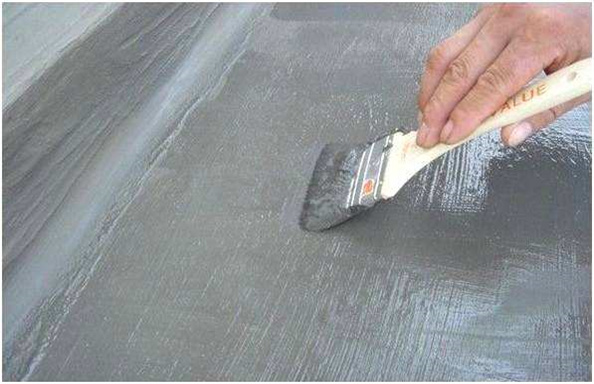
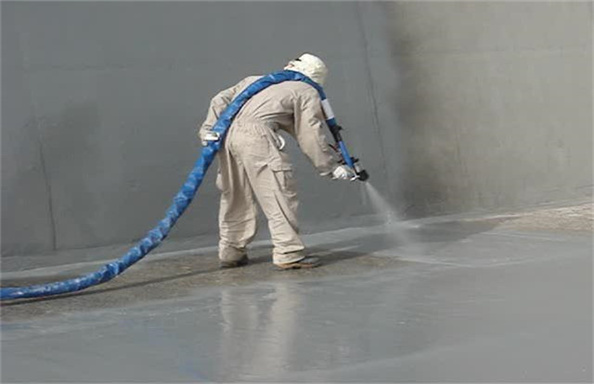
Application
Common Production Challenges
No. | Challenge & Impact | Cause | Raw Material Solution |
1 | Inconsistent curing speed and pot life — bottlenecks, incomplete cure, surface tackiness. | Polyether hydroxyl value variation, TDI NCO content fluctuation, moisture contamination. | Specify polyether with tight hydroxyl tolerance (±1 mg KOH/g); require TDI with NCO content ±0.1%; use nitrogen-blanketed packaging to prevent moisture; provide precise NCO/OH ratio calculation guidance. |
2 | Poor adhesion to substrates — delamination, bond failure, sealant detachment. | High hydrolyzable chloride in TDI, low-purity polyether with oligomer impurities, incorrect NCO/OH ratio. | Use low-hydrolyzable-chloride TDI (<0.01%); specify high-purity polyether with low oligomer content; recommend primer or adhesion promoter; ensure correct stoichiometric ratio for optimal wetting. |
3 | Insufficient weatherability / UV resistance — chalking, cracking, gloss loss outdoors. | High unsaturation in polyether leading to UV degradation, lack of UV stabilizers, aromatic TDI yellowing. | Use low-unsaturation polyether (<0.02 meq/g) for UV stability; recommend HALS/UV absorber additives; consider aliphatic isocyanate (HDI/IPDI) for topcoats; use UV-stabilized TDI prepolymers. |
4 | High viscosity / poor application — difficult spraying, uneven film, poor leveling. | High-MW polyether with broad MWD, high functionality increasing viscosity, low solvent compatibility. | Select lower-MW polyether (MW 1000–2000) for sprayable viscosity; use narrow-MWD polyether for consistent viscosity; recommend reactive diluent or compatible solvent; specify low-viscosity TDI adducts. |
5 | Bubbles and pinholes — aesthetic defects, reduced barrier, premature corrosion. | Excessive moisture in polyether/TDI, high volatile content, improper degassing. | Require ultra-low-moisture polyether (<0.03%) and TDI; use nitrogen-blanketed drums; recommend vacuum degassing; specify low-volatile-grade raw materials; control application humidity. |
6 | Inadequate chemical resistance — softening, degradation, swelling in industrial environments. | Insufficient crosslink density, low-hard-segment content, polyether type selection. | Use higher-functionality polyether (3–4) for crosslink density; increase BDO chain extender content for hard segments; consider polyester polyol blend for solvent resistance; optimize NCO index (1.05–1.15). |
7 | VOC and regulatory compliance — REACH, EPA, CARB, low-odor indoor air quality. | High residual monomer in TDI prepolymer, volatile additives, low-purity raw materials. | Use low-free-TDI prepolymers (<0.1% free TDI); specify low-VOC polyether grades; ensure REACH registration for all substances; provide SDS and regulatory documentation; recommend water-borne or high-solids formulation. |
Recommended Raw Materials
Polyether Polyol For CASE — Base polyol (soft segment)
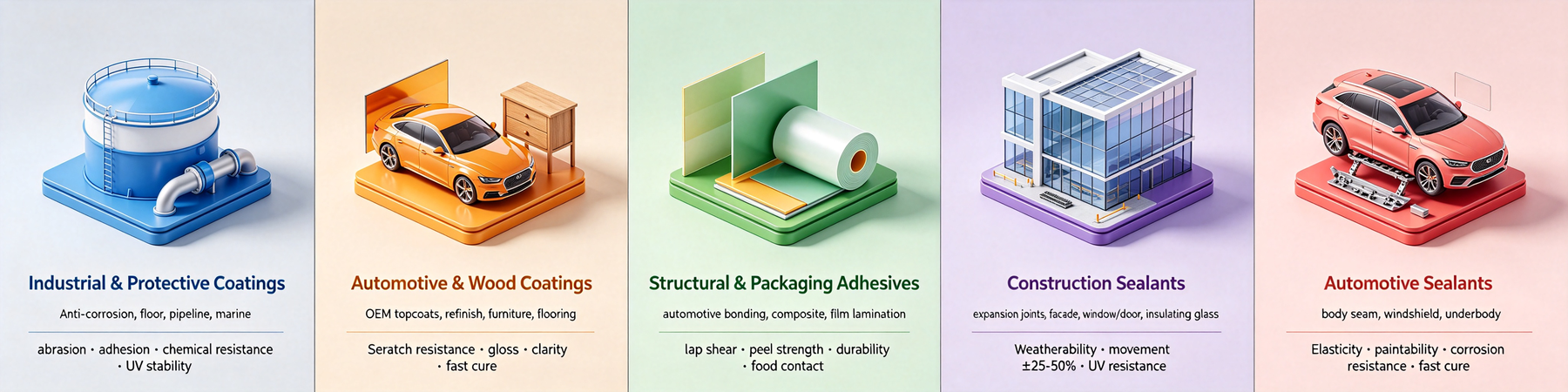
Key applications: Industrial & Protective Coatings, Automotive & Wood Coatings, Structural Adhesives, Construction Sealants, Automotive Sealants.
Solves: Insufficient weatherability/UV resistance, inadequate chemical resistance, high viscosity/poor application.
Low-viscosity, high-purity polyether diol/triol designed for CASE. Controlled molecular weight, low unsaturation (<0.02 meq/g), consistent reactivity. Excellent compatibility with isocyanates, pigments, additives. Superior hydrolysis resistance vs. polyester alternatives. Available in MW 1000–4000 for different viscosity and flexibility requirements.
TDI (Toluene Diisocyanate) — Isocyanate crosslinker
Key applications: 2K Industrial/Wood Coatings, 1K Structural Adhesives, Construction/Automotive Sealants.
Solves: Inconsistent curing/pot life, poor adhesion, bubbles/pinholes (low-moisture grade resolves).
T-80/T-100 for 2K coatings, 1K moisture-curing adhesives, and sealants. Excellent abrasion resistance, good adhesion, balanced mechanical properties. Low-hydrolyzable-chloride grade (<0.01%) for improved adhesion. Prepolymers/adducts available with controlled NCO and low free TDI for safer handling.
BDO (1,4-Butanediol) — Chain extender
Key applications: Industrial & Floor Coatings (hardness/scratch), Structural Adhesives (cohesive strength).
Solves: Inadequate chemical resistance, insufficient hardness/scratch resistance.
Increases coating hardness, scratch and chemical resistance while maintaining flexibility. Improves tensile and tear strength in films and adhesive bonds. High purity (≥99.5%) ensures consistent chain extension. Critical for high-performance industrial coatings, floor coatings, and structural adhesives where hardness and durability are required.

Get a Quote
Tell us your application (coating / adhesive / sealant), target performance, substrate, curing method (1K/2K), application method, and monthly volume — we'll recommend the right raw materials and quote.

Building 8, Capital Airport International Center, No. 6 Changcheng South Road, Qingdao,Shandong Province, China



 Mobile
 wechat
 whatsapp





 Get in touch

 Language

 Back
Back

 Application of polyurethane materials