
 Applications
 Beyond core polyurethane and polymer raw materials, FINEMAX CHEM supplies a range of specialty and auxiliary chemicals that serve as critical performance enablers across multiple industries. Our portfolio includes flame retardants (TCPP), high-boiling industrial solvents (DPMA), and bio-based green solvents (Solketal) — each delivering consistent quality, excellent performance, and full regulatory compliance support.

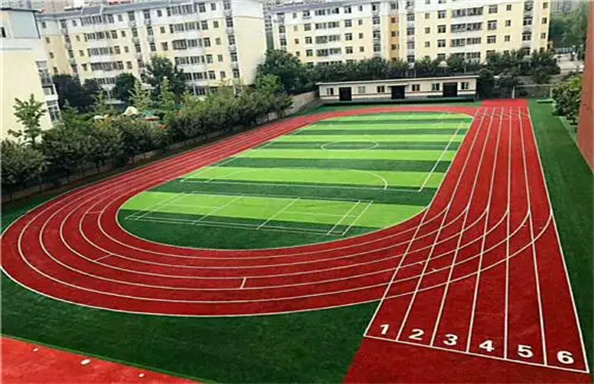
Application
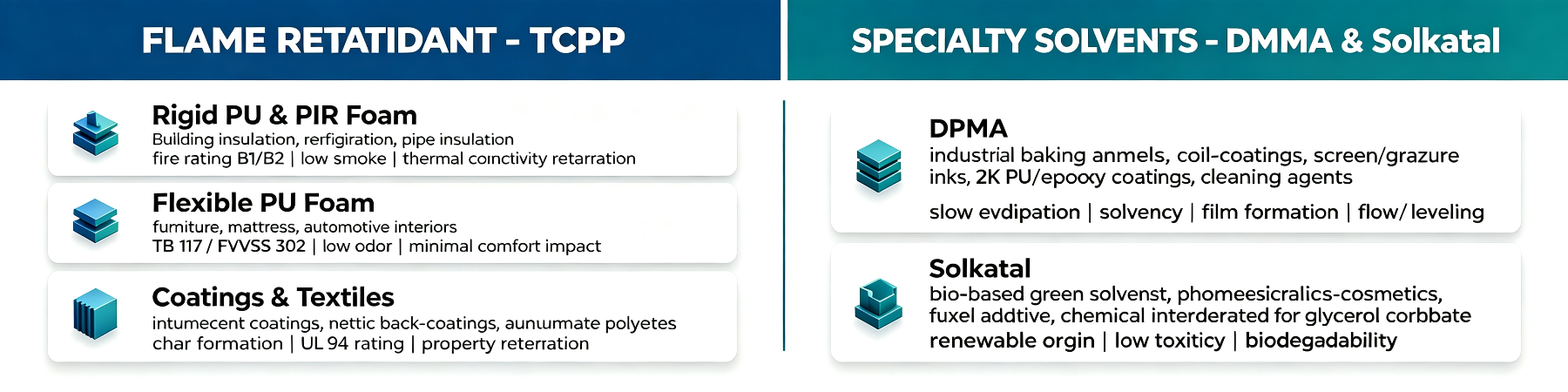
Common Production Challenges
No. | Challenge & Impact | Cause | Raw Material Solution |
1 | Insufficient flame retardancy — fails EN 13501, ASTM E84, UL 94, TB 117, FMVSS 302. | Insufficient TCPP loading, low-purity TCPP with reduced phosphorus content, poor dispersion, lack of synergist. | Use high-purity TCPP (≥99.5%) with guaranteed phosphorus content (9.0–10.0%); optimize loading based on target standard (5–25 php/wt%); recommend melamine/APP synergist for higher ratings; ensure uniform TCPP dispersion via proper mixing; provide flame test data and formulation guidance. |
2 | High flame retardant loading — increased cost, degraded mechanical properties, processing issues. | Low-efficiency flame retardant, incorrect synergistic system, over-engineering for target standard. | Use high-purity TCPP for maximum efficiency at minimum loading; recommend synergistic combination (TCPP + melamine) to reduce total loading; match loading to specific fire standard (not over-engineered); provide cost-performance optimization analysis; recommend high-phosphorus grade. |
3 | Poor compatibility / blooming — phase separation, exudation, surface defects, inconsistent performance. | TCPP polarity mismatch with polymer, low-purity TCPP with impurities, excessive loading, improper mixing. | Specify high-purity TCPP (≥99.5%) with minimal impurities; ensure TCPP is fully miscible with polyol/resin (test compatibility first); control loading within recommended range; recommend proper mixing temperature (25–50°C) and time; use pre-dispersed TCPP masterbatch if needed. |
4 | Thermal instability during processing — decomposition, discoloration, gas formation, equipment corrosion. | High acid value in TCPP, excessive processing temperature, moisture-induced hydrolysis, metal catalysis. | Use low-acid-value TCPP (<0.1 mg KOH/g) to prevent corrosion and decomposition; ensure processing temperature <200°C (TCPP stability limit); control moisture (<0.1%) to prevent hydrolysis; use stainless steel equipment for high-temperature processing; provide thermal stability data. |
5 | Solvent evaporation rate mismatch — film defects (pinholes, orange peel, blushing), poor flow/leveling. | Incorrect solvent boiling point, humidity during application, incompatible solvent blend, insufficient slow solvent. | Select DPMA (bp 200–210°C) as slow-evaporating solvent for flow/leveling; blend with faster solvents for optimal evaporation profile; control application humidity (<70% RH); ensure solvent compatibility with resin system; provide evaporation rate data and formulation guidance; recommend Solketal as renewable slow solvent alternative. |
6 | Insufficient solvency power — resin incompatibility, viscosity issues, pigment dispersion problems. | Incorrect solvent selection, low-purity solvent with reduced solvency, resin-solvent polarity mismatch. | Select DPMA for broad solvency (acrylic, epoxy, polyester, PU, nitrocellulose); use high-purity grade (≥99.0%) for consistent solvency; consider Solketal for polar/non-polar dual solvency; test resin solubility before formulation; recommend solvent blend for optimal viscosity; provide solubility parameter data. |
7 | Regulatory compliance complexity — REACH, RoHS, Prop 65, VOC regulations, varying regional standards. | Unregistered substances, high-VOC solvent, restricted impurities, lack of documentation. | Ensure all products (TCPP, DPMA, Solketal) are REACH-registered; provide full SDS and regulatory documentation; offer low-VOC and high-solids formulation guidance; confirm no RoHS-restricted substances; provide Prop 65 compliance data; offer bio-based Solketal as renewable alternative for green regulations; maintain updated regulatory files. |
8 | Bio-based solvent consistency — renewable feedstock variability, quality inconsistency, cost competitiveness. | Glycerol feedstock quality variation, production process inconsistency, purification level differences. | Specify Solketal with tight purity specification (≥98.0%); require consistent glycerol feedstock source; ensure controlled production process with batch QC; provide COA for every lot; offer cost-performance comparison with petroleum-based solvents; ensure stable supply with backup production capacity; provide renewable content certification. |
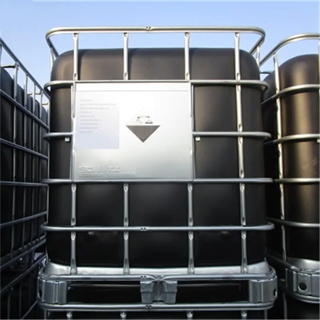
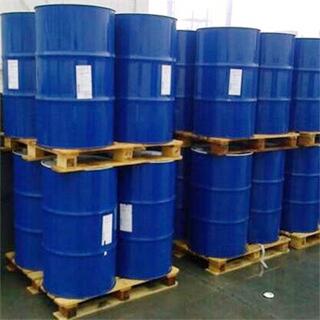
9 | Moisture sensitivity / storage stability — hydrolysis, acid value drift, performance degradation. | High moisture in product, improper storage (open containers, high humidity), long storage time. | Specify low-moisture products (TCPP <0.1%, DPMA <0.1%, Solketal <0.1%); use nitrogen-blanketed drums/IBCs; recommend storage in cool, dry area (15–25°C, <60% RH); ensure sealed containers; provide shelf-life data (typically 12–24 months); recommend moisture testing before use; use desiccant if needed. |
Recommended Raw Materials
TCPP (Tris(2-chloroisopropyl) Phosphate) — Halogenated phosphate flame retardant
Key applications: Rigid PU & PIR Foam (building, refrigeration, pipe), Flexible PU Foam (furniture, automotive), Coatings & Textiles (intumescent, back-coatings, polyester).
Solves: Insufficient flame retardancy, high loading requirement (high-purity efficient), poor compatibility/blooming (high-purity), thermal instability (low-acid grade).
Dual-mechanism flame retardant: condensed-phase char formation + gas-phase radical quenching. High purity (≥99.5%), low acid value (≤0.1 mg KOH/g), low moisture (≤0.1%), low viscosity (40–60 cP). Excellent compatibility with polyols and resins. High phosphorus (≈9.5%) and chlorine (≈32%). Stable to ~200°C. Typical loading: rigid foam 8–15 php; flexible foam 5–12 php; coatings 5–15 wt%; textiles 10–25 wt%.
DPMA (Dipropylene Glycol Methyl Ether Acetate) — High-boiling glycol ether acetate solvent
Key applications: Industrial baking enamels, coil coatings, screen/gravure inks, 2K PU/epoxy coatings, cleaning agents.
Solves: Solvent evaporation rate mismatch (slow evaporation resolves), insufficient solvency power (broad solvency).
Slow-evaporating solvent (bp 200–210°C) with excellent solvency for acrylics, epoxies, polyesters, polyurethanes, nitrocellulose. Promotes film formation, flow, and leveling — reduces pinholes, orange peel, and blushing. Purity ≥99.0%, low water (<0.1%) for 2K systems. High flash point (85–95°C) for safe handling. Ideal as the slow-evaporating component in solvent blends.
Solketal (2,2-Dimethyl-1,3-dioxolane-4-methanol) — Bio-based glycerol-derived solvent
Key applications: Bio-based green solvent, pharmaceuticals/cosmetics, fuel additive, chemical intermediate for glycerol carbonate.
Solves: Regulatory compliance (renewable/bio-based), bio-based solvent consistency (tight spec), evaporation rate mismatch (slow bp alternative).
Renewable solvent from glycerol (biodiesel byproduct). Excellent solvency for both polar and non-polar compounds, low volatility, high boiling point (188–190°C), biodegradable, low environmental impact and toxicity. Used in pharmaceuticals, cosmetics, personal care; as fuel additive (octane improvement, gum reduction); as chemical intermediate for glycerol carbonate synthesis. Purity ≥98.0%. A renewable alternative to petroleum-based slow solvents.

Get a Quote
Tell us your product of interest (TCPP / DPMA / Solketal), application, required specifications, target performance, and monthly volume — we'll provide technical recommendations and a competitive quot

Building 8, Capital Airport International Center, No. 6 Changcheng South Road, Qingdao,Shandong Province, China



 Mobile
 wechat
 whatsapp






 Get in touch

 Language

 Back
Back
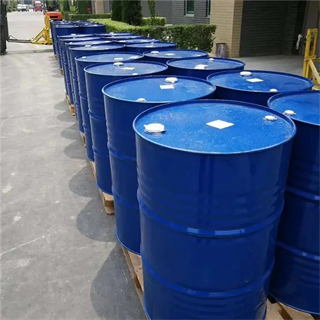

 Polyurethane Coating